If you've never rafted before, the scariest part isn't the water - it's not knowing what's about to happen. The good news: before a single paddle touches the Koprucay, your guide gathers everyone for a short, calm safety briefing that answers every worry in your head.
On the Koprulu Canyon run near Beskonak, this briefing happens at the riverside base camp once you're kitted out in your helmet and life jacket. It usually takes only ten minutes or so, but it's the reason first-timers step off the raft grinning rather than shaking. Here's what your guide will actually tell you.
Your kit, and why it matters
The guide starts with the gear. The helmet and life jacket are compulsory and provided for you, and they'll check each one is snug - the jacket especially, because a loose one rides up in the water. The single most reassuring fact you'll hear: on the family route you do not need to know how to swim. The life jacket is buoyant enough to float you on its own, face-up, whether you can swim or not.
The paddle commands
Rafting is a team sport, and the briefing teaches you the handful of simple commands the guide will call from the back of the raft. You don't need to memorise a manual - it's just a few clear words:
- Forward - everyone paddles ahead together, in rhythm.
- Back paddle - paddle backwards to slow down or reposition.
- Stop - lift your paddle and rest.
- Hold on / get down - grab the safety rope and drop low as you hit a lively rapid.
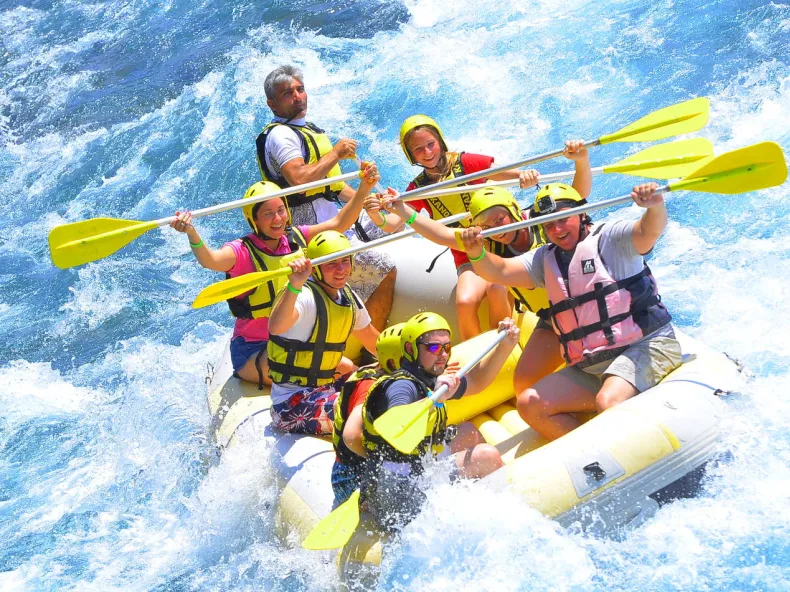
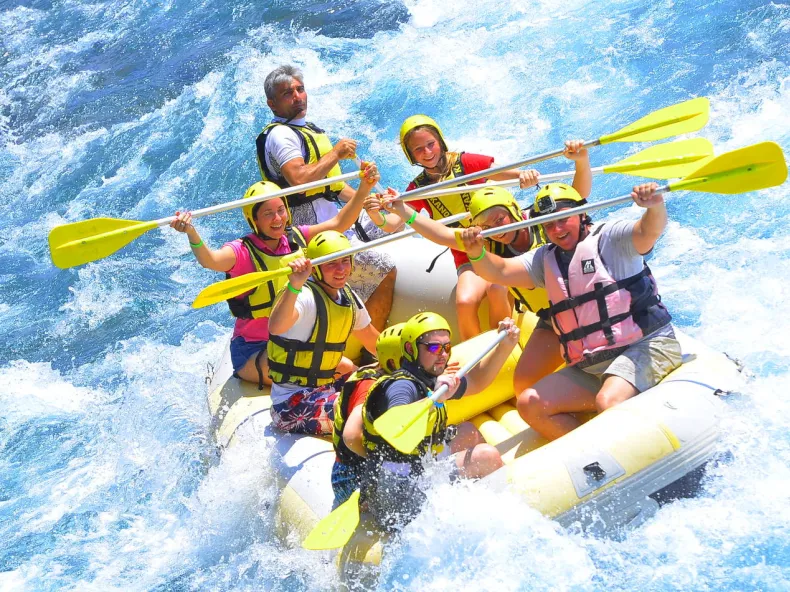
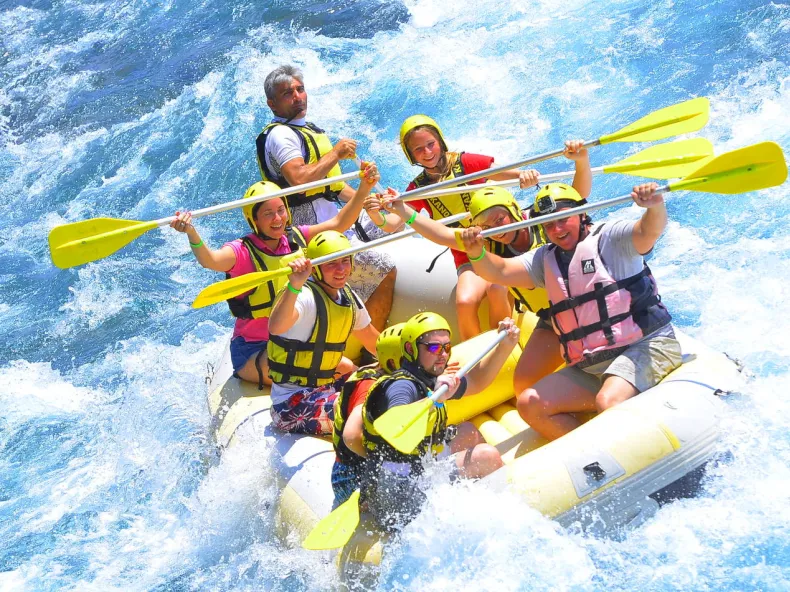
The whole point is teamwork. When six to eight people paddle together on the guide's call, the raft handles the grade II-III rapids easily - and there are plenty of calm pools in between to catch your breath.
How to sit and hold the paddle
Your guide shows you where to plant your feet - wedged under the tube in front - so you stay anchored when the raft bounces. You'll learn the correct grip too: one hand on the shaft, one hand capping the T-grip at the top. That top hand matters, because a loose paddle can swing back and knock a neighbour. It sounds fussy, but after thirty seconds it feels natural.
The safe floating position
This is the part everyone remembers. If you end up in the water - and on a fun rafting day some people happily jump in during the mid-river swim stop - there is one position to adopt: lie on your back, feet up and pointing downstream, toes at the surface, arms out for balance. Feet-first and floating means the current carries you safely and you can push off any rocks with your legs rather than your head. Your guide will demonstrate it clearly so it becomes instinct.
If you go in, what happens next
The guide explains the recovery too, so there's no mystery. Stay in that feet-downstream float and wait - the raft or a guide will reach you in seconds, because the whole team is watching. When help arrives you'll be told to grab the rope or an extended paddle, and you may be hauled back in by the shoulder straps of your jacket. It happens fast and it's completely routine. The cold snowmelt water is the biggest surprise - not the current.
Listen to the guide - that's the golden rule
Everything else comes down to one instruction: listen to your guide and react to their calls. These are trained professionals who run this river all season, they steer from the back, and they read the water far better than any first-timer can. Follow the commands, keep hold of your paddle, and the canyon does the rest. That single habit - eyes and ears on the guide - is what keeps a raft moving smoothly through every rapid.
By the time the briefing ends, the nerves are usually gone. You know the commands, you know how to float, and you know a whole team has your back. Want to see the full day this briefing is part of? Our rafting trips from Side include hotel pickup, all kit and the drive up to Koprulu Canyon, and you can compare every option on our tours page.
Ready to trade the nerves for the best day of your holiday? Book your Koprulu Canyon rafting trip from Side and let the guides do the worrying for you.